Even When You Did Not Answer, You Were There
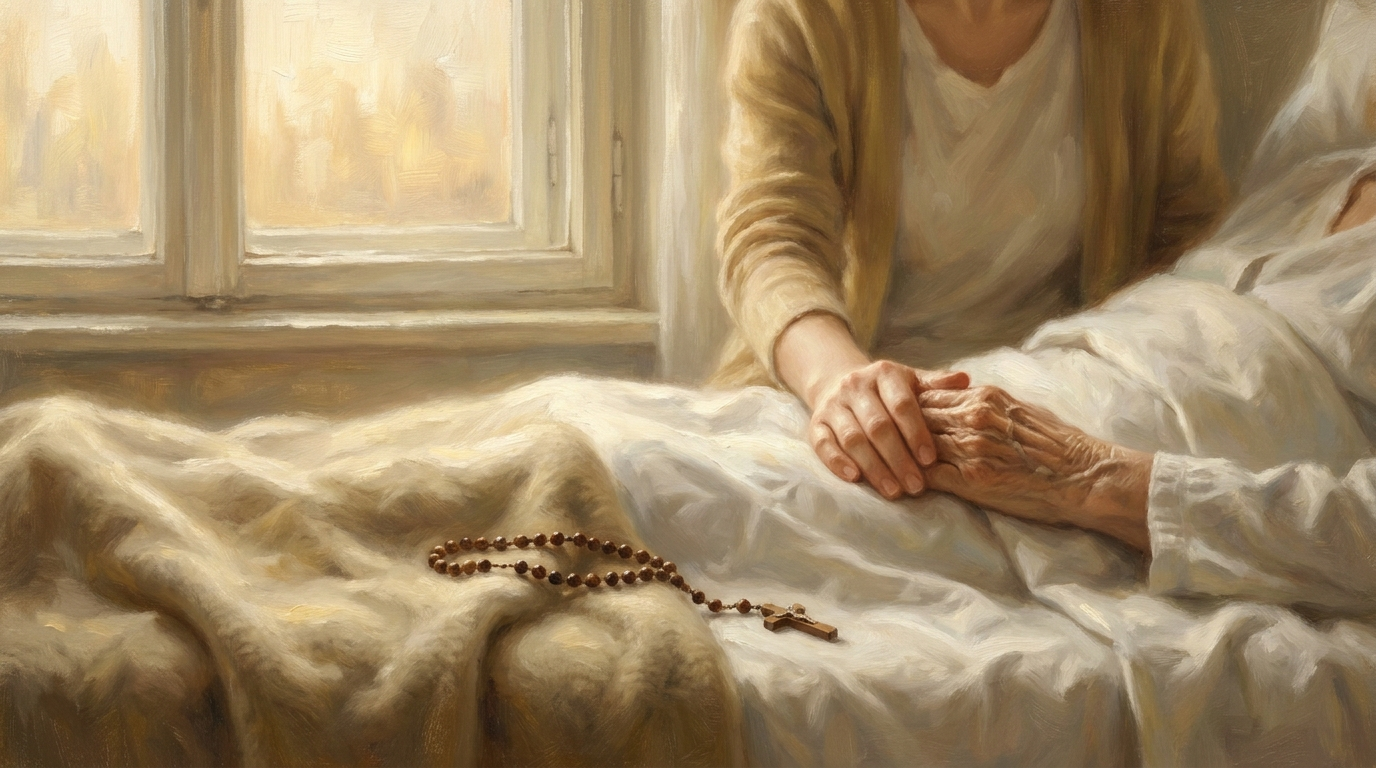
Even in the silence, someone is there.
Even When You Did Not Answer, You Were There
A neurologist remembers three patients, and the dawns he spent beside them
Tae-Ho Guak, MD (John) · Neurologist
Back to the dawn shift in the ER
These days I see patients in an outpatient clinic in Bundang. But when I was first starting out as a neurologist, one of the things I did most often was assess a patient’s level of consciousness in the emergency room.
“Open your eyes for me.” “Squeeze my hand.” “Can you hear my voice?” I would go through the prompts in a fixed order and note at which step the response came, then convert it into a number. That instrument is called the Glasgow Coma Scale. The numbers were added up and written into the chart as a single line: GCS 9. GCS 11. That one line settled the matter of a person’s consciousness. At two in the morning, again at four, I would repeat the same assessment once an hour.
Back then I thought of it as measuring consciousness. I believed a patient’s awareness was expressed in that score. But when I look back on those ER nights now, after many years, one thing has quietly become clear. What I was measuring, over and over, was the patient’s response. The eyes opening. The hand moving. The words coming. And consciousness — consciousness is not a response. It is the place from which a response arises, the experience a response carries with it. That experience itself I had never once seen directly. That I had been assigning scores to something I had never seen was a realization that simply could not surface in those years.
Turn that realization over long enough, and you arrive somewhere unexpected: the very place we failed to see in each of our patients is precisely the place the Catholic Church has known about for a thousand years. That the person dwells beyond the reach of response. That even when they do not answer, they are there.
This is an attempt to sit with that one place — through three patients — and to pray it through together.
The first dawn — the elder in the ward
During my residency there was an elderly man who lay in one hospital room for a long time. After a stroke he had entered a vegetative state. Medically, a vegetative state means this: the eyes open and sleep–wake cycles return, so the person looks awake, but there is no purposeful response. It is a slot on the classification chart marked, from the outside, as without consciousness.
For various reasons his discharge kept falling through, and so he held his place in that room for a long time. On every round I found him in the same bed, in the same posture. His family came every day and held his hand.
One dawn, as his breathing grew ragged, his family said beside him, “Father, we love you.” In that moment the corner of his mouth moved, just slightly, once. I am told the family kept that smile for the rest of their lives.
What that smile was, I could not explain medically at the time. It may have been residual motor-cortex activity. It may have been an unconscious reflex. But what was happening inside him — only he knew. And only the One who made him knew.
Twenty-odd years ago that smile would have been filed under “reflex,” and that would have been the end of it. But in 2006 a research team at the University of Cambridge, led by Professor Adrian Owen, asked a woman who had been diagnosed as vegetative to imagine playing tennis while inside an fMRI scanner. When an ordinary person obliges that request, a particular motor region lights up — and in her, almost exactly the same region lit up. They reported it in Science. Later studies have confirmed that somewhere around ten percent of patients classified as vegetative may be awake on the inside. That silence on the outside need not mean absence on the inside — medicine now knows this in a form it can measure.
The second dawn — the butterfly inside the diving bell
At the close of the twentieth century, a man named Jean-Dominique Bauby, editor-in-chief of the French magazine Elle, suffered a brainstem stroke at forty-three. A small infarct in the ventral pons cut the final pathway carrying motor signals from the cortex down to the spinal cord. His consciousness was perfectly preserved — but the output of every muscle was blocked. In medicine this state is called locked-in syndrome. The only signal he could send to the outside world was the blink of his left eyelid.
With that blink he pointed to the letters of the alphabet, one at a time, and dictated an entire book. A single word took two minutes. The book is titled The Diving Bell and the Butterfly. In one passage he wrote: “My body is heavy as a diving bell. But my mind is free as a butterfly.”
Inside a man who, from the outside, was pure silence, there was a mind that traveled to the ends of the earth. In the place where we could not hear him, he was wide awake. When his family held his hand, he felt that touch completely. He simply had no channel to return it. A few days after the book was published, he died of pneumonia.
The very place that families in Korea meet every day beside a loved one with Alzheimer’s or in a vegetative state — Bauby testified to it once, from the inside. That even when the answer cannot reach us, the love had already arrived.
The third dawn — the elder who remained in the responses of the Mass
There was an elderly woman I used to see in the Bundang clinic. She had Alzheimer’s, and would ask the same question five times in ten minutes. She had forgotten her daughter’s name; she had forgotten yesterday’s meals. And yet, as our appointment drew to a close, she never once forgot the same parting words. She would fold her hands neatly and say, “The Lord be with you.” On the backs of her hands were the faint marks of a rosary — the traces of tens of thousands of turnings over a lifetime.
Her daughter’s name was gone, yet this one line remained. Neuroscience knows why.
Our memory is not a single mass. Episodic memory — what you ate yesterday — is anchored in the hippocampus, deep in the medial temporal lobe, and the hippocampus is precisely the first place Alzheimer’s dismantles. That is why yesterday’s meal is lost. But the movements the body has learned and the prayer worn smooth on the lips — procedural memory — are inscribed in other circuits: the basal ganglia, the motor cortex, the cerebellum. These are among the last places Alzheimer’s invades. Because that circuitry survives to the end, one line memorized over a lifetime — “The Lord be with you” — does not vanish.
The lips move first. It is not that she recalls “God” and then “the Father almighty” follows. If someone beside her begins “I believe in God, the Father almighty…,” the next phrase comes out of her on its own. It is the same circuit that lets you ride a bicycle for the rest of your life once you have learned. Her body remembers the prayer.
And there is one more thing here: emotional memory. The sense of having been loved by someone. The feeling that a certain touch was safe. It is inscribed in the amygdala, and it outlasts the hippocampus by far. Those who have spent a lifetime being loved within their faith remain gentle even after cognition has deeply collapsed. When the priest’s hand touches them, they somehow grow still. This is no coincidence — it is what a whole lifetime laid down in that circuit.
The following spring, that elder forgot even the responses of the Mass. When it became too difficult to bring her out to the clinic, she moved to a nursing home. In Korea, hospice care is almost never open to patients with dementia as the place to spend their final days. Because hospice wards are mostly run for cancer patients, it is not realistically easy for a person with late-stage dementia to use that space. And so many of Korea’s elderly with dementia — she among them — meet the last place of their lives in a nursing home.
What came next I heard much later, directly from her daughter. One day the parish priest came to the nursing home to administer the Anointing of the Sick. When his hand rested on her forehead and the line “Peace be with you” flowed out, the elder lifted her eyes for a moment and smiled. Her daughter has kept that last smile for the rest of her life.
What the three of them taught, together
That the three of them, in their separate dawns, were pointing to one and the same place — this I understood only long afterward.
For all three, silence on the outside did not mean absence on the inside. The elder in the vegetative state, Bauby in his locked-in syndrome, the elder with Alzheimer’s — all three were awake in a place we could not measure. Their personhood had gone nowhere. We simply had no channel to it.
Catholic theology holds an ancient answer to this place. The person is not the sum of functions. Following Boethius, the tradition defines the person as an individual substance of a rational nature — a definition St. Thomas Aquinas carried forward. Even when function collapses, the substance remains where it is. In the twentieth century the Catholic theologian Karl Rahner refounded the same insight in a different language: the human person is, in itself, a self-opening toward holy mystery. That openness lies beyond the channel we call response. Even when the response stops, the openness stays where it is.
So when the Church gives the Anointing of the Sick to a patient to the very end, it is not a mere custom. It rests on a very precise theological premise: that grace acts even when cognition is damaged. There is a single foundation here — that the sacrament is effective ex opere operato, by the very fact of the act being performed. When the priest’s hand rests on the forehead, that one act does not depend on the patient’s conscious understanding. Because the person is present in that place, in whatever manner, the sacrament reaches them.
This theological premise fits, astonishingly, with twenty-first-century neuroscience. That around ten percent of vegetative patients are awake inside the fMRI, the Cambridge team confirmed. That a prayer inscribed in the body of an Alzheimer’s patient survives to the end, neurology has confirmed again and again. The perfect consciousness of locked-in syndrome, Bauby’s book bore witness to. What the Church has assumed for a thousand years, neuroscience is now confirming again, in a form it can measure.
Beyond the closed door
All three of them were like closed doors — doors that give little answer no matter how you knock from outside. We often grow weary before such a door. “What if there is no one there anymore?” “What if all this care is in vain?” This wavering strikes at the hearts of families and caregivers every day.
But there is one truth the three of them taught, each in their own dawn.
Behind the closed door — someone was always there. In the place we could not hear, they were awake. The one word we could not make audible — “Father, we love you,” “Peace be with you” — had reached the deepest place in them. Of that reaching we held no outward proof. Only the corner of a mouth moved, for a moment. That single movement teaches us for a lifetime.
And there is one truth deeper still that the Catholic faith knows.
In that place our love could not reach — the Lord had already gone. When a family said “we love you” to the elder in the vegetative state, how far into him that one word traveled, we do not know. By outward signals there is no way to confirm its arrival. And yet — there is one thing the Church has known for a thousand years. To the place we could not carry it, the Lord goes first. The family’s love does not scatter into empty air. The Lord receives that love and delivers it directly to the deepest place in the person. In that place of handing-over that we cannot see, the Lord is already present.
There is a line in Korean Catholic devotion that expresses this most tenderly — the single intention prayed in the parish for a gravely ill person: “Lord, fill up what is lacking in us.” That one line points exactly here. Our love is insufficient. We cannot make it reach. But the Lord fills the gap. He makes it reach in our place. This is why a family holds a hand every day, why a caregiver stops beside the bed every day, why a priest gives the sacrament to the very end. It is why none of those acts scatter into empty air.
A one-line meditation
Let us not stop before the one who does not answer.
Whether they are awake we cannot know from the outside. But the fact that we do not know is no proof that they are not there. They may be awake. And if they are awake — then our love reaches them. It has never once flowed without reaching. Even when we cannot make it reach, the Lord makes it reach.
Let us knock on the closed door every day. Let us speak one word of love to them every day. Our voice, in the deepest place within them — together with the Lord — is keeping watch over them.
Those three dawns left this one truth as a gift for a lifetime.
— From a clinic in Bundang, Tae-Ho Guak (John)


댓글
댓글 쓰기